Modern Monetary Theory (MMT) has emerged from academic heterodoxy to influence real-world policy discussions, presenting a fundamental challenge to traditional fiscal and monetary frameworks. The theory's core insight—that sovereign governments issuing fiat currency face different constraints than currency users—has gained practical relevance as nations grapple with massive deficits, persistent unemployment, and inflation pressures. Recent experiences from Japan's decades-long monetary expansion to the unprecedented fiscal responses during COVID-19 provide compelling test cases for MMT's predictions, while critics point to inflation surges and currency crises as evidence of the theory's limitations.
MMT's rise coincides with a period of extraordinary monetary policy accommodation and fiscal expansion across developed economies. The theory offers a systematic framework for understanding why countries like Japan can sustain debt-to-GDP ratios exceeding 250% without triggering fiscal crises, while also explaining the mechanisms behind the massive pandemic-era stimulus programs that prevented economic collapse. Yet the 2021-2023 inflation surge and recent currency crises in emerging markets have intensified debates about MMT's practical viability and theoretical foundations.
Core principles in fiat currency systems
MMT's theoretical foundation rests on the operational realities of fiat currency systems, where governments possess monetary sovereignty—the ability to issue currency without external constraints. The theory distinguishes between currency issuers (sovereign governments) and currency users (households, businesses, and non-sovereign entities), arguing this fundamental difference reshapes fiscal policy possibilities.
The sectoral balances framework provides MMT's analytical core, demonstrating that government deficits mathematically equal the sum of private sector and foreign sector surpluses. This accounting identity reveals that when governments run deficits, they inject net financial assets into the private sector, challenging traditional views of deficits as inherently problematic.
Under MMT, government spending occurs through a straightforward process: the Treasury instructs the central bank to spend, which credits the recipient's commercial bank reserves, and the bank credits the recipient's account. This creates money "ex nihilo" without requiring prior tax collection or borrowing, fundamentally altering the perceived constraints on fiscal policy.
Taxation serves multiple functions beyond revenue generation: creating demand for government currency, providing fiscal space for spending without triggering inflation, and redistributing resources. The functional finance approach judges fiscal policy by its economic effects rather than budgetary balance, with inflation—not deficits—representing the primary constraint on government spending.
Real-world applications and current context
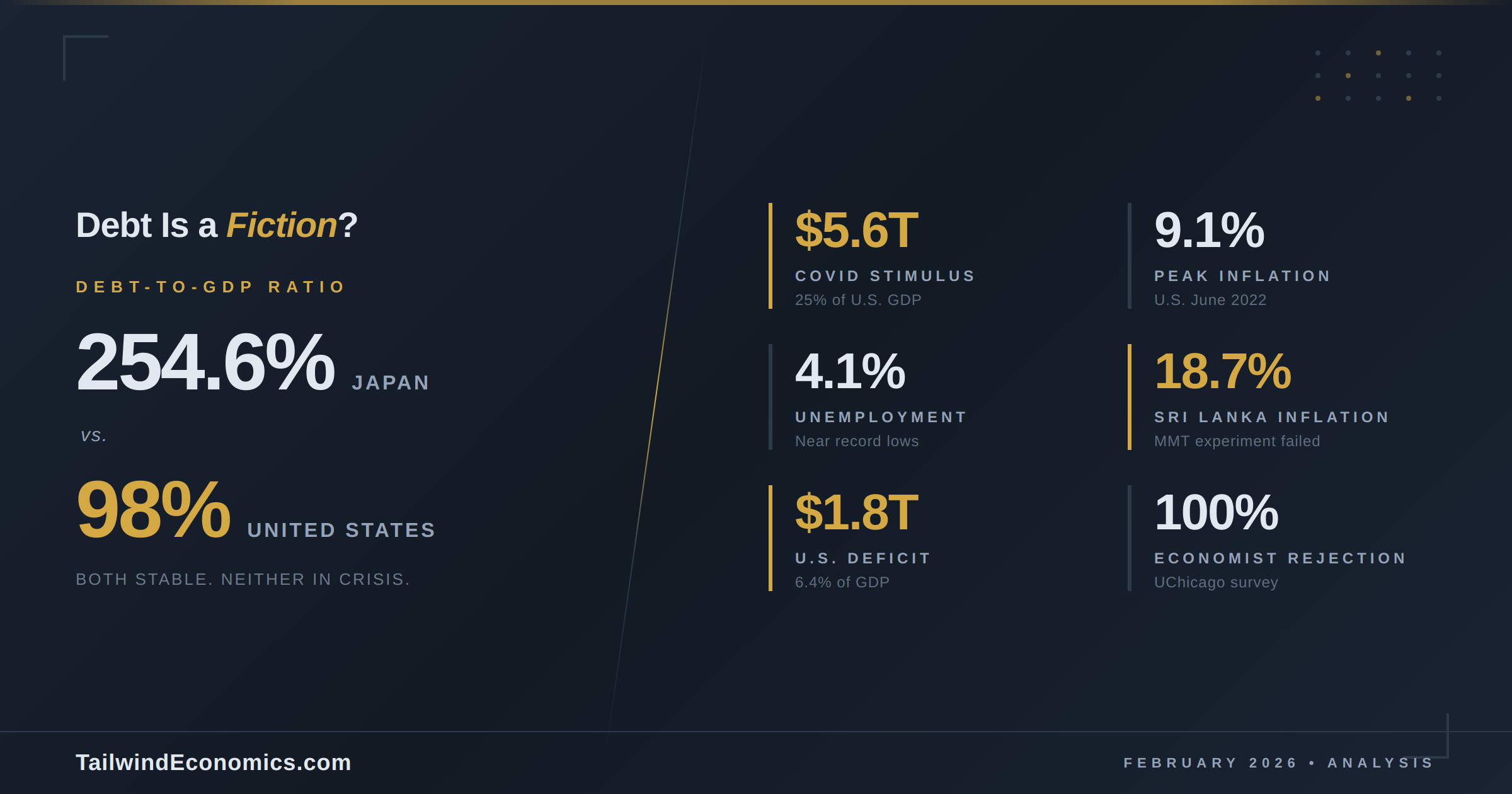
Japan remains the closest real-world analog to MMT implementation, with government debt reaching 254.6% of GDP in 2024 while maintaining price stability and full employment. Despite this enormous debt burden, Japan has avoided fiscal crisis, lending credence to MMT's predictions about monetary sovereignty. The Bank of Japan's massive government bond holdings effectively monetize debt, while recent interest rate increases from -0.1% to 0.5% demonstrate policy flexibility even at extreme debt levels.
The U.S. COVID-19 response represented the largest MMT-style intervention in modern history, with fiscal measures exceeding $5.6 trillion (over 25% of GDP) accompanied by Federal Reserve balance sheet expansion. Current outcomes show mixed results: unemployment remains low at 4.1-4.2%, but inflation peaked at 9.1% in 2022 before moderating to 2.4% by May 2025. The federal deficit continues at $1.8 trillion (6.4% of GDP) with debt-to-GDP at 98%.
Across major economies, the data reveals divergent experiences with MMT-inspired policies. While OECD unemployment averages 4.9% near record lows, inflation rates vary significantly—from China's -0.1% to Russia's 10.3%. Government debt-to-GDP ratios show extreme variation, with Japan leading at 254.6%, followed by Greece at 163.6%, suggesting that institutional factors and economic structure matter significantly for MMT implementation.
Critical perspectives challenge core assumptions
Academic opposition to MMT remains overwhelming, with University of Chicago surveys showing unanimous rejection among leading economists. Nobel laureates Paul Krugman and Lawrence Summers have characterized MMT as "fallacious" and potentially leading to hyperinflation, while Federal Reserve Chairman Jerome Powell explicitly rejected the theory's core premises.
The Sri Lanka experience provides empirical evidence against MMT claims. When the country's central bank cited MMT as justification for monetary expansion in 2020-2021, the results were catastrophic: inflation reached 18.7%, the currency collapsed, and the country defaulted on foreign debt. While MMT proponents argue this wasn't a true implementation due to structural constraints, the episode highlights practical limitations of the theory.
Critics focus on several fundamental issues: MMT's inflation theory lacks mathematical rigor and contradicts historical evidence from hyperinflationary episodes; the political feasibility of using taxation to control inflation faces severe constraints; and the theory's mixing of fiscal and monetary policy roles creates governance challenges. Scott Sumner of the Mercatus Center notes that MMT has "constructed such a bizarre, illogical, convoluted way of thinking about macro[economics] that it's almost impervious to attack."
The recent inflation surge has intensified criticism, as MMT advocates failed to predict the price pressures that emerged after massive fiscal stimulus. Despite claiming proactive inflation-fighting capabilities, MMT proponents called for continued spending during inflationary periods, contradicting their theoretical framework.
Policy implications and stakeholder considerations
For policymakers, MMT offers both opportunities and risks. The theory provides intellectual justification for aggressive fiscal expansion during economic crises, as demonstrated by pandemic responses. However, implementation requires fundamental institutional changes, including modified central bank mandates, rapid tax adjustment mechanisms, and new frameworks for fiscal-monetary coordination.
The proposed job guarantee program exemplifies MMT's policy ambitions: government employment at a fixed wage ($15/hour proposed) for anyone willing to work. This would create a "buffer stock" of employed workers instead of unemployed, potentially controlling inflation without unemployment costs. Yet the administrative complexity and political sustainability of such programs remain questionable.
Investors face significant implications under MMT implementation. Fixed income markets would experience structural changes as government bonds become less about credit risk and more about inflation expectations. Currency markets might see increased volatility as international investors assess MMT policies' sustainability. Portfolio strategies would need to emphasize real assets and inflation hedges over traditional government securities.
Current market conditions present mixed signals for MMT viability. Interest rate normalization increases traditional debt service costs, while persistent inflation challenges MMT's demand-focused inflation theory. The Federal Reserve's commitment to independence creates institutional resistance to MMT-style fiscal-monetary coordination.
Navigating theory and practice
Modern Monetary Theory's evolution from academic heterodoxy to policy influence reflects genuine insights about fiat currency operations, yet its practical implementation faces formidable challenges. The theory accurately describes how government spending creates money and challenges traditional deficit concerns, but struggles with inflation control mechanisms and political feasibility constraints.
Recent experiences provide mixed evidence: Japan's decades of stability with extreme debt levels support MMT predictions, while inflation surges and currency crises demonstrate the theory's limitations. The optimal approach likely involves selective adoption of MMT insights within existing institutional frameworks rather than wholesale transformation.
For stakeholders, MMT represents both expanded policy possibilities and significant risks. Policymakers can draw on MMT insights for crisis response while maintaining traditional fiscal discipline during normal times. Investors should prepare for potential MMT-inspired policies through diversification and inflation hedging strategies. Central banks face pressure to accommodate fiscal expansion while preserving their independence and credibility.
The ongoing MMT debate reflects deeper questions about the proper roles of fiscal and monetary policy in modern economies. As governments confront climate change, inequality, and economic security challenges requiring sustained fiscal expansion, MMT's insights about monetary sovereignty become increasingly relevant—even as its practical limitations remain substantial constraints on implementation.