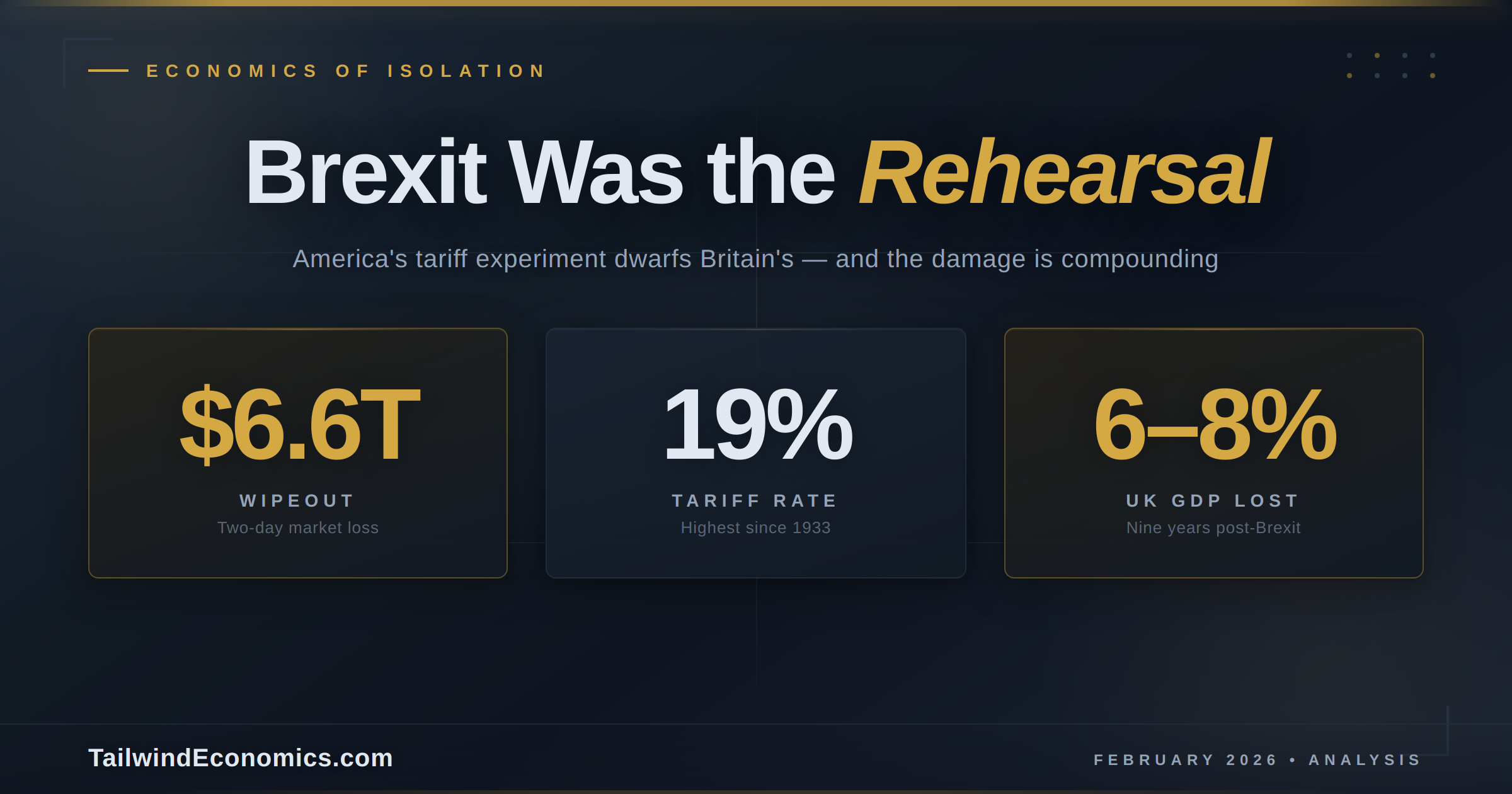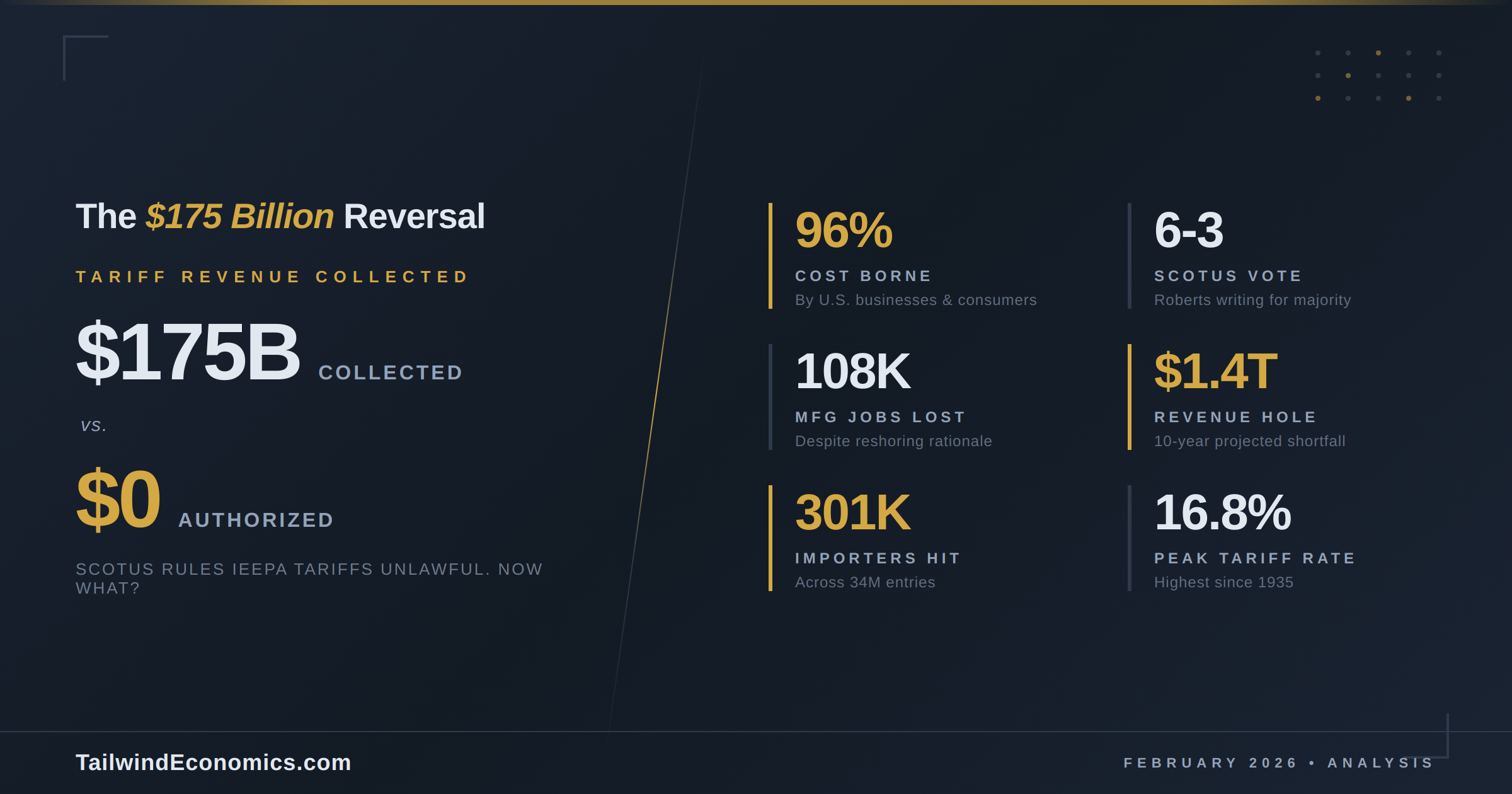
The U.S. Supreme Court ruled 6-3 on February 20, 2026, that President Trump lacked authority to impose tariffs under the International Emergency Economic Powers Act, invalidating the most sweeping unilateral trade action in modern American history. Chief Justice John Roberts, writing for the majority in Learning Resources, Inc. v. Trump, held that IEEPA's grant of power to "regulate importation" does not encompass the power to impose tariffs — a distinction that eliminates roughly 60% of all tariff revenue collected since early 2025 and creates a refund liability estimated between $150 billion and $175 billion. The ruling reshapes the balance of trade authority between Congress and the executive branch, with immediate consequences for the federal budget, global supply chains, and hundreds of thousands of American businesses. It does not, however, end the tariff era: Section 232 levies on steel, aluminum, copper, autos, and lumber remain intact, and the administration has signaled it will pursue alternative statutory pathways to reimpose duties.
Six justices agreed on the result, but split on why
The opinion structure reveals important fault lines. All six majority justices — Roberts, Gorsuch, Barrett, Sotomayor, Kagan, and Jackson — agreed that IEEPA's text simply does not authorize tariffs. Roberts identified several converging signals: IEEPA contains no reference to "tariffs," "duties," or "taxes"; Congress has never used the word "regulate" to authorize taxation in any statute; when Congress grants tariff authority (Sections 201, 232, 301), it does so explicitly; and no president in IEEPA's nearly 50-year history had ever invoked it for tariffs.
Roberts wrote: "Had Congress intended to convey the distinct and extraordinary power to impose tariffs, it would have done so expressly, as it consistently has in other tariff statutes." He added: "The Government thus concedes that the President enjoys no inherent authority to impose tariffs during peacetime."
The majority fractured, however, on the major questions doctrine. Roberts, Gorsuch, and Barrett applied this doctrine — established in West Virginia v. EPA and Biden v. Nebraska — holding that tariffs of "vast economic and political significance" require unambiguous congressional authorization. Gorsuch warned in concurrence that upholding the tariffs would create "a one-way ratchet toward the gradual but continual accretion of power in the executive branch." Barrett noted bluntly: "The Framers gave 'Congress alone' the power to impose tariffs during peacetime."
Justice Kagan, joined by Sotomayor and Jackson, concurred in the judgment but explicitly rejected the major questions doctrine as unnecessary. "Straight-up statutory construction resolves this case for me," she wrote. "Nothing in IEEPA's text, nor anything in its context, enables the President to unilaterally impose tariffs." Jackson separately would have consulted legislative history to confirm Congress never intended IEEPA to authorize tariffs.
Justice Kavanaugh authored the principal dissent, joined by Thomas and Alito, arguing that "tariffs are a traditional and common tool to regulate importation" and that text, history, and precedent "clearly" support the President's authority. Kavanaugh raised a pointed practical warning: "The Court says nothing today about whether, and if so how, the Government should go about returning the billions of dollars that it has collected from importers."
The $175 billion refund question nobody can answer yet
The ruling's most consequential aftershock is the refund obligation. Under established U.S. law, customs duties collected without statutory authority constitute an illegal exaction — the government cannot lawfully retain them. The Supreme Court in United States v. United States Shoe Corp. previously required the government to return unlawfully collected taxes including interest. DOJ counsel has conceded on the record that the Court of International Trade has authority to order reliquidation and refunds.
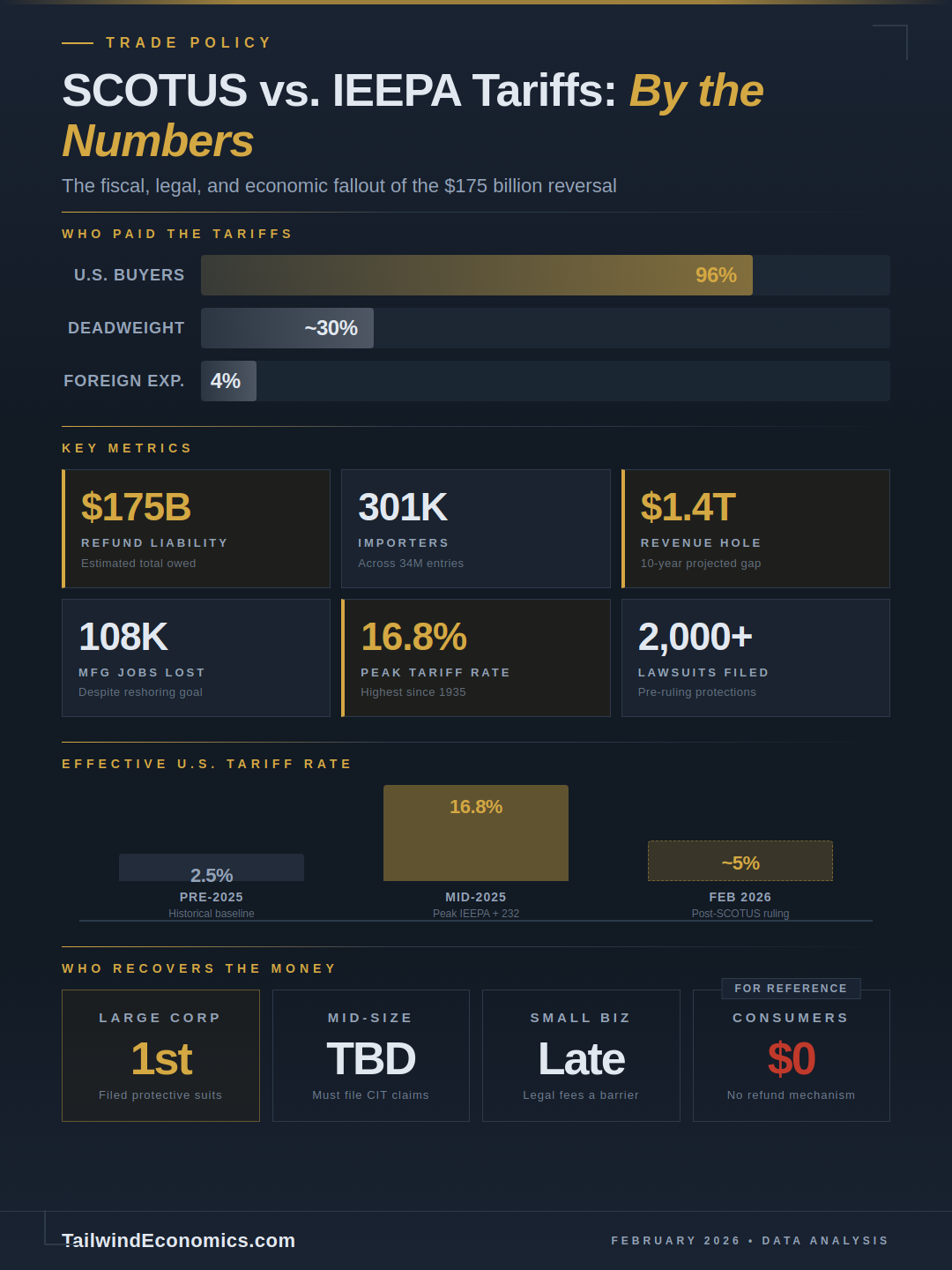
But the scale is unprecedented. CBP collected approximately $133.5 billion in IEEPA tariffs through mid-December 2025, affecting roughly 301,000 importers across 34 million entries. Penn-Wharton Budget Model estimates total refund liability at $175 billion or more when including collections through the ruling date. No modern precedent exists for a refund operation of this magnitude — the largest comparable case, a 1980s export tax invalidation, involved just $730 million over two years.
Three primary refund pathways exist for importers. Post-Summary Corrections allow importers with unliquidated entries to amend filings immediately. Formal protests under 19 U.S.C. § 1514 cover entries already liquidated, but carry a strict 180-day filing deadline. Court-ordered reliquidation through the CIT represents the most likely mass mechanism. Over 2,000 protective lawsuits were filed before the ruling by companies including Costco, Toyota subsidiaries, and Revlon. Companies that failed to file protective actions before their entries liquidated may be permanently barred from recovery.
The timeline remains deeply uncertain. Morgan Stanley expects "a few months would pass before refunds begin, and even longer if the distribution faces significant legal challenges." Trump himself acknowledged the difficulty in January, writing on Truth Social that refunds "would take many years to figure out." The "We Pay the Tariffs" coalition of 800+ small businesses demanded "full, fast and automatic" refunds, but analysts widely expect the process to take months to years. Consumer refunds are essentially impossible — no mechanism exists to trace which end-buyers paid tariff-inflated prices on which goods.
A $2 trillion hole in the fiscal plan
The fiscal ramifications extend far beyond the immediate refund liability. IEEPA tariffs constituted roughly 60% of all new tariff revenue and were projected to generate $1.4 trillion over the next decade. The Committee for a Responsible Federal Budget estimates the ruling will leave the country "about $2 trillion deeper in the hole" over ten years absent replacement revenue. The effective tariff rate drops immediately from approximately 9.5% to 5%, according to PNC Financial.
This creates acute budget arithmetic problems. The administration's "One Big Beautiful Bill Act" relied on tariff revenue to offset roughly two-thirds to four-fifths of its estimated $4.1 trillion cost. Without IEEPA tariffs, remaining levies under Sections 232 and 301 would generate only about $53.8 billion in 2026 versus the $171 billion projected with IEEPA tariffs in place. The CBO's projected FY2026 deficit of $1.9 trillion could swell further, and debt-to-GDP ratios could reach 127% by 2035 rather than the already-concerning 122%.
The administration has signaled it will attempt to replicate IEEPA tariffs through alternative authorities. Section 232 requires Commerce Department national security investigations. Section 301 demands USTR fact-finding, typically taking nine months or more. Section 122 caps tariffs at 15% for only 150 days. None offers the speed, breadth, or flexibility that made IEEPA the administration's preferred instrument. As one NPR analyst noted, these alternatives "don't allow the president to roll out of bed and impose a 50% tax."
American businesses paid 96% of the cost
The economic evidence is unambiguous about who bore the burden of these tariffs. A January 2026 Kiel Institute study analyzing over 25 million shipment records found 96% of tariff costs fell on American importers and consumers, with foreign exporters absorbing only about 4%. Import prices rose nearly one-for-one with tariff rates — near-complete pass-through. The Federal Reserve Bank of New York reached a similar conclusion, finding businesses and consumers bore nearly 90% of tariff costs in 2025.
The damage was broad and deep. U.S. manufacturing shed 108,000 jobs in 2025 despite the tariffs' ostensible purpose of protecting domestic industry. The ISM Manufacturing Index spent much of the year in contraction. The National Association of Manufacturers reported 80% of members paid tariffs on imported inputs, and noted domestic industry can only produce 84% of the inputs manufacturers need — the remaining 16% must come from abroad. One large power-engineering manufacturer importing $100+ million annually in Mexican components faced $25 million in additional tariff costs. A major appliance manufacturer absorbed $231 million in combined tariff and retaliatory duty costs.
Construction was especially hard-hit, though much of the pain persists because Section 232 tariffs remain: 50% on steel and aluminum, 50% on copper products, 25% on autos, and 10-45% on lumber. Small businesses suffered disproportionately. One coalition member described having "no more than a 30-day cash reserve" and said "reimbursement at this point doesn't make up for the disruption of staff cuts or hiring we could have made." CNBC reported that tariffs created "a market grab opportunity for larger businesses" that could absorb costs while smaller competitors folded. Legal fees to pursue refunds through the CIT — potentially tens to hundreds of thousands of dollars — add another barrier for small firms.
The per-household cost estimates converge around $1,000 to $2,100 annually, depending on the methodology. The Yale Budget Lab found that tariffs at their peak pushed the average effective rate to 16.8% — the highest since 1935. Tariffs proved regressive, hitting lower-income households proportionally harder because they spend a larger share of income on goods. The Peterson Institute calculated deadweight loss — pure economic waste — at approximately 30% of tariff revenue raised.
Markets shrugged, expecting a tariff sequel
Financial markets reacted with surprising calm. The S&P 500 rose 0.3% to 0.6%, recovering from morning losses driven by weak Q4 GDP data (1.4% versus 2.5% expected). The Nasdaq gained 0.5% to 1%. The Dow added 94 points after falling 200 earlier in the session. Furniture and retail stocks led gains — Wayfair surged over 5%, RH gained 4% — while gold and silver dipped briefly before recovering.
The muted reaction reflected Wall Street's expectation that tariffs would be reimposed through alternative authorities. JPMorgan had assigned 64% probability to the scenario where tariffs are struck down but quickly replaced, projecting only a marginal S&P 500 gain. The scenario of tariffs being struck down with no replacement — which would have sent stocks up 1.5% to 2% — was assigned just 1% probability. Bond yields rose modestly, with the 10-year Treasury reaching 4.09%, as investors weighed the fiscal implications of $150+ billion in potential refunds.
Political reactions broke predictably along partisan lines, with one notable exception. Trump called the ruling "a disgrace" and said he had "a backup plan." Six House Republicans who had voted to repeal Canada tariffs praised the decision. Representative Don Bacon called it "common sense" and said "Article One gives tariff authority to Congress." Democrats framed the ruling as vindication, with the House Majority PAC noting that "vulnerable House Republicans repeatedly voted to enable Trump's tariffs, which raised prices and wreaked economic havoc."
A constitutional correction decades in the making
The ruling represents the most significant judicial check on executive trade authority since IEEPA's enactment in 1977 — itself a post-Watergate reform designed to narrow presidential emergency powers. The irony is precise: a statute created to constrain executive overreach was stretched to justify the broadest unilateral tariff action since the Smoot-Hawley era. The Court's response restores the constitutional architecture: Article I, Section 8 grants Congress the power to "lay and collect Taxes, Duties, Imposts and Excises," and the majority made clear this is not a power that can be smuggled into a sanctions statute through the word "regulate."
The practical implications extend beyond tariffs. The ruling marks the first application of the major questions doctrine in a foreign affairs and national security context — a significant expansion, even if only three justices joined that portion of the opinion. It establishes that emergency statutes do not create blanket exceptions to judicial review of executive overreach. And it forces the administration onto statutory terrain where trade actions require investigations, findings, consultations, and time — the very constraints IEEPA allowed them to bypass.
This ruling does not end American protectionism
Section 232 tariffs covering steel, aluminum, copper, autos, and lumber remain fully operative, keeping the effective tariff rate around 5% — still more than double pre-2025 levels. The administration will pursue alternative authorities, though these are slower, narrower, and more legally constrained. What the ruling definitively ends is the legal fiction that a Cold War-era sanctions statute could serve as a blank check for unlimited tariff authority. The $150-175 billion refund process will be logistically nightmarish, fiscally consequential, and deeply inequitable — large corporations with protective filings will recover first, while small businesses and end consumers who bore the real costs may never see a dollar returned. The deeper lesson is structural: tariffs extracted roughly $200 billion from American businesses and households, with 96% of costs falling domestically, while producing net manufacturing job losses and GDP contraction. The Court corrected a legal error. The economic damage is already done.